

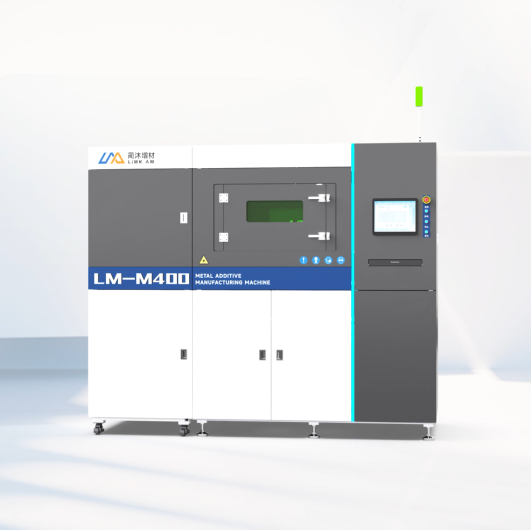
Large metal components with intricate channels, integrated structures, and demanding performance requirements can be difficult to manufacture efficiently through conventional machining. Metal additive manufacturing provides a different approach by building components layer by layer from digital models. For manufacturers evaluating an industrial metal 3D printer, the key question is not simply whether a machine can produce a large part, but whether it can combine build coverage, productivity, process control, and operational efficiency for real production needs.
Why Metal Additive Manufacturing Suits Complex Parts
Metal powder bed fusion is one of the established approaches within metal additive manufacturing. NIST explains that powder bed fusion builds parts by melting and fusing successive layers of powdered material with a laser or electron beam. The process can create functional metal components with geometries that may be difficult to produce using conventional manufacturing methods.
This design freedom is particularly valuable for industries such as aerospace, energy, automotive, mold manufacturing, and precision engineering. Complex internal passages, lightweight structures, lattice features, and consolidated components can be incorporated into a single design rather than being divided into multiple conventionally manufactured pieces.
For large parts, however, geometry is only one consideration. A larger build area can allow manufacturers to produce bigger components or arrange more parts within one build. At the same time, productivity and thermal management become increasingly important because large builds can involve substantial powder volumes and long processing cycles.
What to Look for in an Industrial Metal 3D Printer
When selecting an industrial metal 3D printer, manufacturers should evaluate the complete production system instead of focusing on a single specification. Build size, laser configuration, scanning strategy, layer thickness, powder handling, software, protective-gas management, and process development capabilities can all influence production performance.
Multi-laser architecture is particularly relevant when production volume is high. Multiple lasers can distribute scanning work across a larger forming area, but their practical value depends on how effectively the machine coordinates laser coverage and energy delivery.
NIST research also highlights that metal powder bed fusion can face challenges related to part quality and process consistency. Factors affecting the final result include process conditions, geometry, and other variables that must be controlled throughout production.
Consequently, an industrial system designed for large components needs more than high laser power. Coordinated scanning, calibration, process parameters, and controlled powder handling are important parts of a production-oriented solution.
How the LiMN 3D LM-M400 Addresses Large Builds
LiMN 3D offers several metal additive manufacturing systems, including the LM-M100D Lite, LM-M120D Lite, LM-M150, LM-M280, LM-M400, and LM-M800. Its applications cover aerospace, automotive parts, consumer electronics, heat exchangers, medical and dental production, mold manufacturing, shoe molds, and research.
Among these systems, the LM-M400 is positioned for larger-scale industrial metal additive manufacturing. It adopts metal powder bed melting technology and is equipped with four 500 W lasers as standard. According to the supplied product information, its maximum forming efficiency reaches 140 cm³/h, supporting higher printing efficiency for demanding production environments.
The machine’s XY-axis forming size is described by the manufacturer as the highest among similar products. Its quad-laser configuration allows each laser to achieve full coverage of the build area through a coordinated scanning strategy. The stated objective is uniform energy control across the forming area, an important consideration when producing larger components.
The LM-M400 also uses an advanced multi-laser scanning strategy and calibration algorithm. Rather than treating laser quantity as the sole productivity measure, this approach combines multiple laser sources with software-based control to support efficient scanning and controllable production quality.
Powder Management Matters for Large-Scale Production
Large builds can require substantial quantities of metal powder, making powder handling an important part of the manufacturing workflow. The LM-M400 is designed with short sieving times for large powder volumes and a closed powder circulation loop.
The system’s process chain can operate under a protective gas atmosphere across sieving, printing, cooling, and de-powdering. For industrial users, integrating these stages can help establish a more controlled workflow while addressing powder-handling and operational-safety requirements.
This type of integrated approach is relevant to companies moving from individual prototypes toward repeatable production. Instead of evaluating printing speed separately from powder preparation and recovery, manufacturers can assess the complete workflow surrounding the build.
Software and Process Control Support Production Flexibility
Complex metal components often require process development rather than a fixed, one-size-fits-all configuration. LiMN 3D states that the LM-M400’s software, algorithms, and control system are independently developed by Linmu3D. The company also states that process parameters are open and can be personalized for different production requirements.
The broader LiMN 3D platform emphasizes independently developed SLM technology and complete metal 3D printing solutions, supported by Linmu Laser’s experience in the laser industry. Its website identifies aerospace, precision processing, mold manufacturing, healthcare, and other demanding applications among its target fields.
For manufacturers, this emphasis on software and process control can be useful when different geometries or production objectives require customized parameter development. It also gives engineering teams another factor to consider alongside machine dimensions and laser specifications.
Turning Large-Format Printing Into Production Value
A large machine does not automatically make every large component economical to print. Manufacturers still need to assess material selection, geometry, support structures, post-processing, inspection, production volume, and required quality controls.
Metal additive manufacturing becomes more compelling when the design benefits directly from additive capabilities. NIST notes that powder bed fusion can support complex and low-volume functional parts and can reduce assembly requirements by enabling more integrated designs.
For companies producing aerospace structures, heat-management components, molds, or other intricate metal parts, the combination of build capacity and process control can therefore be more important than headline machine size alone.
A Scalable Approach to Complex Metal Production
The right industrial metal 3D printer should support the complete manufacturing workflow, from powder preparation and laser scanning to cooling, de-powdering, and process management. LiMN 3D’s LM-M400 combines metal powder bed melting, four 500 W lasers, a stated maximum forming efficiency of 140 cm³/h, full-area multi-laser scanning, closed powder circulation, and independently developed software and control technology.
For manufacturers investigating larger and more complex metal components, these capabilities provide a practical basis for evaluating whether a large-format metal additive manufacturing system can fit their production strategy.