

Bridging standard copper Ethernet cabling with long-range fiber optic infrastructure requires dedicated physical-layer signal adaptation. An ethernet to fiber media converter functions as an electro-optical adapter, transforming electrical pulses traveling over twisted-pair copper wire into light pulses suitable for glass optical fiber strands. This media conversion takes place transparently at the physical layer, preserving original Ethernet packet headers, Media Access Control (MAC) addresses, and higher-layer transport protocols without introducing complex packet processing overhead.
Distance restrictions inherent to copper infrastructure restrict localized data links to approximately one hundred meters. Transitioning data streams onto single-mode or multimode fiber extends communication reach across expansive university campuses, industrial sites, and urban networks. Integrating optical translation hardware allows network administrators to preserve existing copper switches and edge devices while utilizing high-speed optical lines for long-haul data transport.
Low latency and high transmission throughput remain essential performance metrics for hardware operating between copper and fiber domains. Modern signal converters maintain continuous transmission speeds with minimal frame delay, supporting real-time data exchange for automated industrial equipment, surveillance feeds, and voice channels. Physical-layer conversion allows legacy switch ports to interface directly with modern fiber backbones across expanding operational environments.
Electro-Optical Processing and 3R Signal Regeneration
Long-distance optical links frequently encounter signal attenuation, dispersion, and timing jitter as light travels through optical glass. Advanced signal converters address these transmission losses by incorporating 3R functionalities—specifically Regeneration, Reshaping, and Retiming. Regeneration restores weak incoming optical power to standard voltage levels, while Reshaping restores distorted wave patterns to clean digital pulses. Retiming synchronizes output data pulses with an internal clock source, reducing phase jitter across high-speed connections.
Combining these three optical processing steps helps maintain signal integrity across multi-kilometer transmission links. Unmanaged signal degradation can increase Bit Error Rates (BER) and trigger packet retransmissions on host networks. By continuously conditioning the optical signal, 3R-capable hardware makes certain that photodetectors process clean, jitter-free digital streams.
Hardware units featuring 3R functionality operate effectively in environments where high electromagnetic interference or extended fiber lengths degrade signal quality. Industrial automation setups and power utility networks benefit from active signal restoration along critical communication paths. Incorporating 3R technology helps prevent link failure caused by optical power decay over extended distribution routes.
High-Bandwidth Transmission and Jumbo Frame Support
Modern enterprise applications continuously generate large data bursts that require substantial physical-layer throughput. Standard Ethernet frames carry payloads up to 1500 bytes, but modern storage area networks and video streaming nodes frequently utilize Jumbo Frames reaching 9000 bytes or more. Media conversion devices supporting Jumbo Frames pass oversized packets without performing unnecessary frame fragmentation, reducing CPU processing overhead on connected switches and servers.
High-throughput media converters handle variable frame sizes while maintaining full gigabit or ten-gigabit data rates. Throughput stability depends on internal frame buffers capable of handling transient traffic spikes without dropping data packets. Efficient frame forwarding helps prevent network bottlenecks between gigabit copper endpoints and high-speed optical trunk lines.
Sustaining uncompromised data flow across varied media types requires alignment between port speed capacities and buffer mechanisms. Industrial monitoring networks sending continuous high-definition video streams rely on steady packet throughput to avoid frame dropping or latency jitter. Hardware supporting large frame sizes facilitates seamless data transfer between core optical networks and copper edge hardware.
Physical Form Factors and Industrial Mounting Architecture
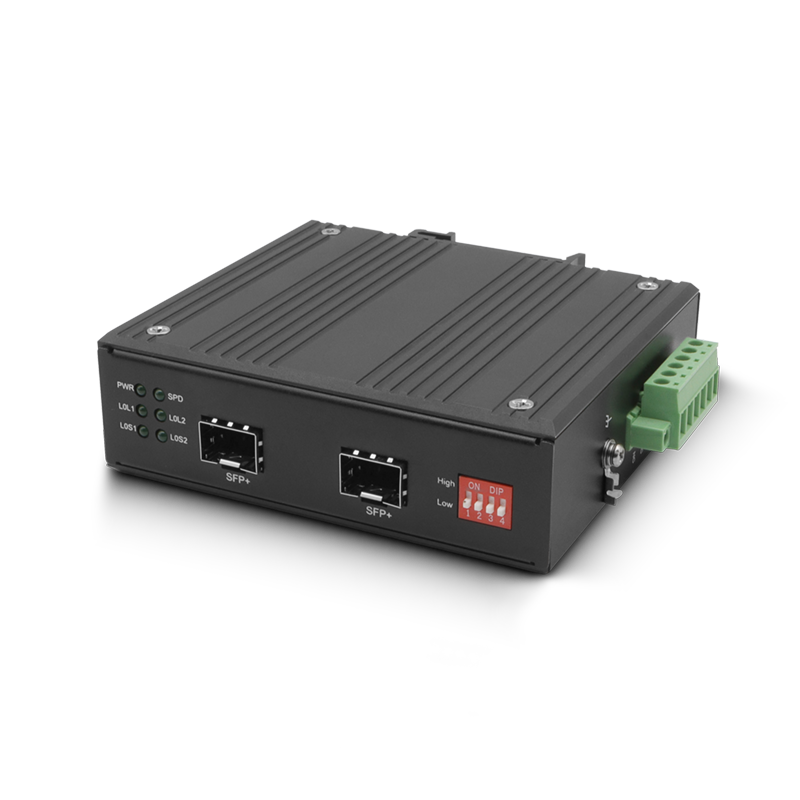
Physical mounting designs determine how signal conversion devices fit into varied deployment environments. Compact desktop enclosures suit office cabinets and small distribution boxes, while modular rack-mount chassis host dozens of converter blades inside centralized server rooms. For industrial installations, DIN-rail mounting options offer secure attachment inside standard electrical panels and outdoor traffic cabinets.
DIN-rail mountable hardware withstands structural vibration and mechanical shock common in factory floors and transportation hubs. Enclosures constructed from heavy-gauge aluminum or steel assist in heat dissipation while shielding internal electronics from dust and moisture. Industrial mounting configurations streamline cabinet organization and protect wiring connections in space-constrained industrial enclosures.
Power options for industrial mounting systems often include dual redundant DC power inputs alongside standard grounding terminals. Redundant power feeds help maintain continuous device operation if a primary power supply experiences an outage. Robust physical casing combined with flexible mounting options helps field hardware operate reliably across harsh industrial environments.
Hot-Swappable Module Integration and Maintenance Operations
System availability relies heavily on hot-swappable hardware architectures that permit component replacement without powering down host equipment. Pluggable optical interfaces allow technicians to remove and insert optical transceivers while the host switch or converter chassis remains fully energized. Hot plugging minimizes planned downtime during network upgrades or routine maintenance procedures.
Pluggable architectures also offer flexibility when matching optical transceivers to specific link requirements. Rather than replacing an entire hardware unit, network technicians simply swap pluggable optical modules to adapt to changing fiber types, wavelengths, or transmission distances. This modular design lowers total ownership costs and simplifies spare parts inventory management.
Streamlining field service operations reduces overall network management complexity across remote installations. Technicians can replace faulty transceivers or reconfigure optical wavelengths without disrupting adjacent hardware modules in the same rack enclosure. Hot-swappable functionality supports continuous uptime across high-availability industrial and enterprise infrastructures.
Wavelength Conversion and High-Speed Optical Protocols
Complex optical networks often require translating light signals between different optical wavelengths or mode types. A 10G SFP+ Wavelength Converter allows operators to interface short-wavelength multimode signals with long-wavelength single-mode fibers, or re-map wavelengths within Wavelength Division Multiplexing (WDM) systems. Converting wavelengths at physical network boundaries optimizes optical spectrum utilization across shared fiber cables.
High-speed wavelength conversion hardware supports diverse optical protocols, including 10G Ethernet, Synchronous Optical Networking (SONET), and Fiber Channel. Operating transparently across multiple optical bitrates enables a single conversion platform to handle diverse communication traffic. Multi-protocol transparency allows network architects to aggregate distinct data types onto unified fiber backbones.
Integrating wavelength converters into existing optical routes delays the need for expensive fiber infrastructure replacement. Network expansion projects can utilize available WDM channels by converting standard optical outputs into specific WDM wavelengths. Flexible wavelength translation enhances network scalability while maximizing returns on installed optical cable assets.
Deployment Scenarios across Industrial and Enterprise Networks
Diverse operational environments demand specialized media conversion hardware tailored to specific field conditions. Industrial automation facilities rely on hardened converters to connect Programmable Logic Controllers (PLCs) with central control rooms across long factory floors. Smart city traffic management systems utilize outdoor ethernet to fiber media converter units to backhaul high-definition surveillance camera feeds from roadside cabinets back to central monitoring facilities.
Enterprise campus networks deploy media conversion hardware to link isolated office buildings with central data centers. Interconnecting distinct facilities via optical fiber provides immunity against lightning strikes and electrical ground loops that commonly affect outdoor copper cable runs. Fiber-based links maintain secure, noise-free communication channels between distant enterprise sites.
Evaluating bandwidth requirements, mounting constraints, and environmental factors helps system designers select appropriate conversion hardware. Products such as the WINTOP WT-F2F-WSFP converter illustrate how modular SFP+ slots and DIN-rail designs address demanding industrial wavelength conversion requirements. Deploying tested conversion hardware builds robust communication bridges across hybrid network architectures.
Conclusion
Understanding the operational mechanics, signal processing features, and physical form factors of electro-optical conversion devices allows engineers to build resilient communication networks. Selecting hardware with appropriate mounting options, frame support, and signal conditioning functionality helps bridge distinct network topologies cleanly and cost-effectively.
Shenzhen Wintop Optical Technology Co., Ltd. brings 21 years of specialized expertise as a national high-tech enterprise focused on optical communication engineering and manufacturing. Backed by 60 core patents and an extensive international distribution network, WINTOP delivers industrial switches, PoE devices, and specialized ethernet to fiber media converter hardware like the DIN-rail type WT-F2F-WSFP model to clients across 40 countries. Reach out to technical specialists today to discuss customized optical conversion solutions for upcoming infrastructure projects.