

A commercial aquatic attraction can look promising on paper while still carrying financial, operational, or site risks. Before committing capital, developers need to connect market demand with land conditions, infrastructure, attraction capacity, safety requirements, and operating costs. A disciplined review helps identify whether the concept is practical.
- Start With the Market and Site
The first question is not which attraction to buy, but who the park is designed to serve. IAAPA recommends determining the target market, location, park size, investment level, and attraction offering early in planning. Research should examine tourism, seasonality, competition, spending, and the catchment area.
Site conditions are equally important. Land, access, utilities, drainage, climate, and regulations can influence the attraction mix and construction budget. A water park feasibility study should connect these physical factors with realistic attendance and revenue assumptions rather than treating them separately.
- Define the Investment Scope Before Equipment Selection
Developers should establish a capital budget before selecting attractions. Land development, civil works, pools, buildings, utilities, water treatment, landscaping, guest facilities, staffing, and contingencies can affect the final investment.
The water park investment checklist should also consider operating expenditure. Water and electricity consumption, maintenance, inspections, spare parts, insurance, staffing, and marketing can influence long-term performance. A project may still be unsuitable if broader requirements are underestimated.
- Test Attraction Capacity Against Guest Flow
Attraction capacity should be assessed as part of the complete park circulation plan. A high-capacity ride can process visitors efficiently, but queues, dispatch procedures, landing areas, and connecting paths also affect the guest experience. IAAPA provides industry research covering attraction mix, admissions, staffing, visitor information, revenue, and expenses, showing why capacity belongs alongside wider operating metrics.
For developers working with a water park manufacturer, the discussion should cover more than appearance and purchase price. Suppliers should provide information about rider configuration, dimensions, capacity, installation requirements, and operating considerations so planners can incorporate each attraction into the master plan.
- Review Safety and Engineering Requirements
Safety and engineering should be addressed before procurement. ASTM F2376-24 applies to the classification, design, manufacture, construction, auditing, major modification, and operation of commercial water slide systems. Its scope includes the flume, water-circulation system, starting platform, structural supports, associated vehicles or accessories, and slide termination. Local authorities may impose additional requirements.
For a water slide project, buyers should ask potential suppliers about engineering documentation, structural calculations, materials, installation procedures, inspection requirements, and applicable standards. These questions clarify regulatory suitability and responsibilities between supplier, contractor, engineer, and owner.
- Consider a Signature Attraction: Twin Racing Slide
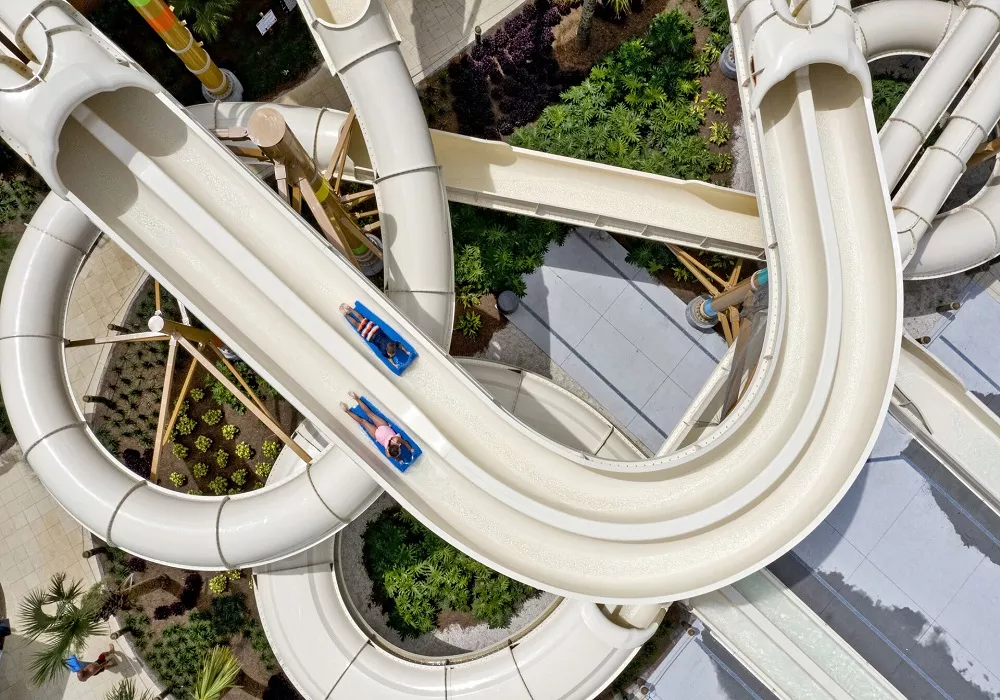
A signature attraction can strengthen a park’s identity when its concept fits the target audience and available site. Jinchao’s Twin Racing Slide is designed around side-by-side competition, with one lane for each rider. Riders start from a 12–15-meter-high platform with a mat, spiral downward, pass through a dark tunnel, emerge into daylight, and continue across wave-like rainbow lanes before slowing at the finish.
The published specifications are useful for preliminary planning. The Twin Racing Slide has a 0.8-meter flume width, accommodates one person per lane, and has an approximate hourly capacity of 300–400 persons per hour. Its starting height also needs to be considered alongside structural, access, circulation, and site planning.
- Evaluate the Supplier as a Project Partner
Equipment procurement is only one stage of a development. Buyers should examine a supplier’s design capability, manufacturing resources, project coordination, installation support, documentation, and after-sales service. Jinchao describes itself as a professional water slide builder serving commercial water parks, resorts, and aquatic attractions worldwide.
Its official site identifies Guangzhou Jinchao Water Park Construction Co., Ltd. as a manufacturer and installer of large amusement rides, with a manufacturing base of approximately 36,000 square meters. The company says it provides integrated water park design, equipment manufacturing, and construction support, backed by 15 years of experience and an R&D team.
A capable water park manufacturer should be able to discuss how an attraction fits the project rather than treating equipment selection as an isolated transaction.
- Build a Decision Framework Before Commitment
The water park project feasibility process should finish with documented assumptions, not simply a decision to purchase equipment. Developers can summarize market evidence, site constraints, capital requirements, operating costs, expected capacity, regulatory requirements, construction schedules, and major risks. Each assumption should be traceable to a reliable source or project-specific quotation.
A water slide should be assessed according to its intended audience, footprint, capacity, engineering requirements, operational role, maintenance needs, and contribution to the overall guest journey. This approach helps prevent an attractive individual ride from driving an unsuitable park-wide plan.
Turning Preliminary Checks Into a Stronger Project
A feasible water park depends on the interaction of market demand, site conditions, investment resources, attraction performance, safety, and operational planning. No single attraction determines project success, but well-defined specifications can make early planning more precise.
Jinchao‘s Twin Racing Slide offers a concrete example for developers evaluating a competitive attraction: a 12–15-meter starting height, 0.8-meter flume width, one rider per lane, and approximately 300–400 persons per hour. Where the concept and site requirements align, supplier discussions can move the plan from preliminary assumptions toward engineering and procurement.
Working with an experienced water park manufacturer can support that transition by connecting attraction design with manufacturing and project execution. The most useful review turns market research, technical information, and financial assumptions into a clear project brief before major commitments.