

Converter manufacturers face growing demands for higher power density, improved conversion efficiency, reliable operation, and scalable production. Meeting these requirements involves more than selecting suitable semiconductor modules. Gate-drive technology, protection circuits, power-stack integration, and testing procedures must work together as a coordinated system.
Turnkey power solutions offer manufacturers a way to simplify this process by combining relevant hardware, engineering expertise, and technical support. For companies developing industrial converters and high-power applications, this approach can reduce integration complexity and create a more structured path from prototype development to volume production.
Understanding Turnkey Power Solutions in Power Electronics
A turnkey power solution generally refers to an integrated package of products and engineering services designed to address a specific power-conversion requirement. Depending on the project, it may include semiconductor drivers, power stacks, control interfaces, testing equipment, and technical assistance.
For converter manufacturers, the value lies in coordinating these elements rather than sourcing and integrating every component independently. Different suppliers may provide compatible individual products, but manufacturers still need to verify electrical interfaces, protection coordination, thermal behavior, and mechanical integration.
Working with an experienced supplier can help streamline these activities. Engineering teams can discuss system requirements earlier, identify potential compatibility issues, and establish clearer responsibilities for development and validation. However, the scope of each turnkey power solution should be defined according to the customer’s application and production objectives.
Why Integrated Engineering Matters to Converter Manufacturers
Power converter development involves several interconnected engineering disciplines. Semiconductor selection influences switching characteristics, while gate-drive design affects transition behavior, losses, and electrical stress. Thermal management and electromagnetic compatibility (EMC) introduce additional considerations.
When these elements are developed separately, engineering teams may spend considerable time coordinating specifications and resolving integration problems. Differences in technical documentation, component interfaces, and supplier response times can further delay development.
An integrated engineering approach provides a more coordinated way to address these requirements. Suppliers with expertise in power semiconductor drivers and power stacks can help manufacturers evaluate component compatibility and identify suitable configurations.
This collaboration is particularly useful for specialized industrial equipment, where standard components may require adjustments to meet voltage, current, topology, and environmental requirements.
The Role of an IGBT Gate Driver in Power Conversion
The gate driver connects converter control electronics with power semiconductor devices, supplying the gate voltage and current required for switching. An IGBT gate driver therefore plays an important role in determining switching performance, protection behavior, and overall converter reliability.
Engineers must evaluate several parameters when selecting a driver, including peak gate current, output power, positive and negative gate voltages, operating temperature, and interface configuration. Protection functions are equally important. Undervoltage lockout (UVLO) helps prevent operation with insufficient gate-drive voltage, while short-circuit protection can initiate a controlled shutdown when abnormal current conditions occur.
For high-voltage converters, the driver’s compatibility with the selected semiconductor module and circuit topology requires particular attention. Multi-level converter architectures may also introduce specific requirements for coordinated switching and fault management.
Selecting a driver as part of a broader system design can help manufacturers evaluate these factors together instead of treating the component as an isolated purchase.
Digital ASIC Technology and Intelligent Fault Management
Digital application-specific integrated circuit (ASIC) technology provides a platform for developing specialized semiconductor drivers. It enables manufacturers to integrate dedicated control and protection functions into compact driver architectures.
Intelligent fault management is particularly relevant to high-power converter applications. Different abnormal conditions may require different responses, making fault identification and reporting valuable during system operation and troubleshooting.
For example, short circuits and gate-drive undervoltage are distinct conditions with different causes and protection requirements. A driver capable of differentiating between faults can provide more useful diagnostic information to the wider control system, depending on its implementation.
These capabilities do not eliminate the need for external protection or system-level validation. Instead, they contribute to a more coordinated protection strategy when integrated with appropriate converter controls.
Firstack 2FHC0660: A Driver Core for High-Voltage Applications
Firstack is a high-tech enterprise specializing in the research, development, and sales of power semiconductor drivers, power stacks, and testing equipment. Its product portfolio supports customers requiring individual driver boards as well as coordinated engineering assistance for mass-production projects.
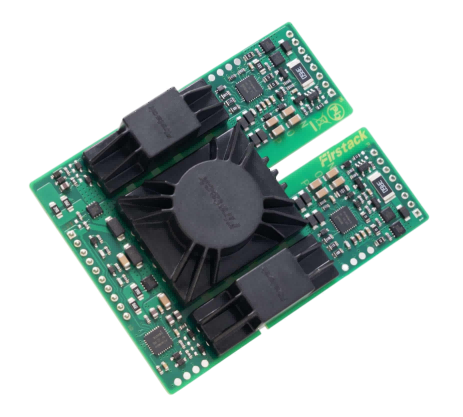
The 2FHC0660 is a dual-channel gate driver core based on digital ASIC technology. According to its supplied product specifications, it supports IGBT power modules rated up to 3300 V, with a 15 V gate voltage in the on-state. The driver provides 6 W output power and a peak gate current of 60 A.
The product also supports multi-level topology and features electrical interfaces. Its documented protection and management functions include short-circuit protection with soft shutdown, undervoltage lockout, and intelligent fault management. The latter allows the driver core to differentiate between faults.
These characteristics make the 2FHC0660 relevant for evaluation in high-voltage power conversion designs. Manufacturers should confirm the exact electrical requirements, module compatibility, and applicable technical documentation before integrating it into a specific converter platform.
From Prototype Development to Volume Production
A successful converter project requires continuity between initial engineering and manufacturing. A design that performs well in a laboratory prototype must also demonstrate repeatable performance, stable component quality, and manageable production processes.
Manufacturers should establish testing procedures, acceptance criteria, documentation requirements, and engineering change controls before scaling production. Thermal testing, switching-waveform analysis, protection verification, and EMC assessment can help identify issues before equipment enters service.
Firstack’s engineering collaboration model supports customers from initial samples toward volume delivery, with technical communication between supplier engineers and customer teams. This type of cooperation can be valuable when a turnkey power solution involves multiple components or application-specific integration requirements.
Building a More Coordinated Converter Development Process
Turnkey power solutions help converter manufacturers manage the technical and organizational demands of power electronics development. By coordinating semiconductor drivers, power stacks, protection functions, and engineering support, manufacturers can establish a clearer development process from component evaluation to production. With its digital ASIC-based driver technology and products such as the 2FHC0660, Firstack offers capabilities for companies evaluating integrated solutions for high-voltage converter applications.