

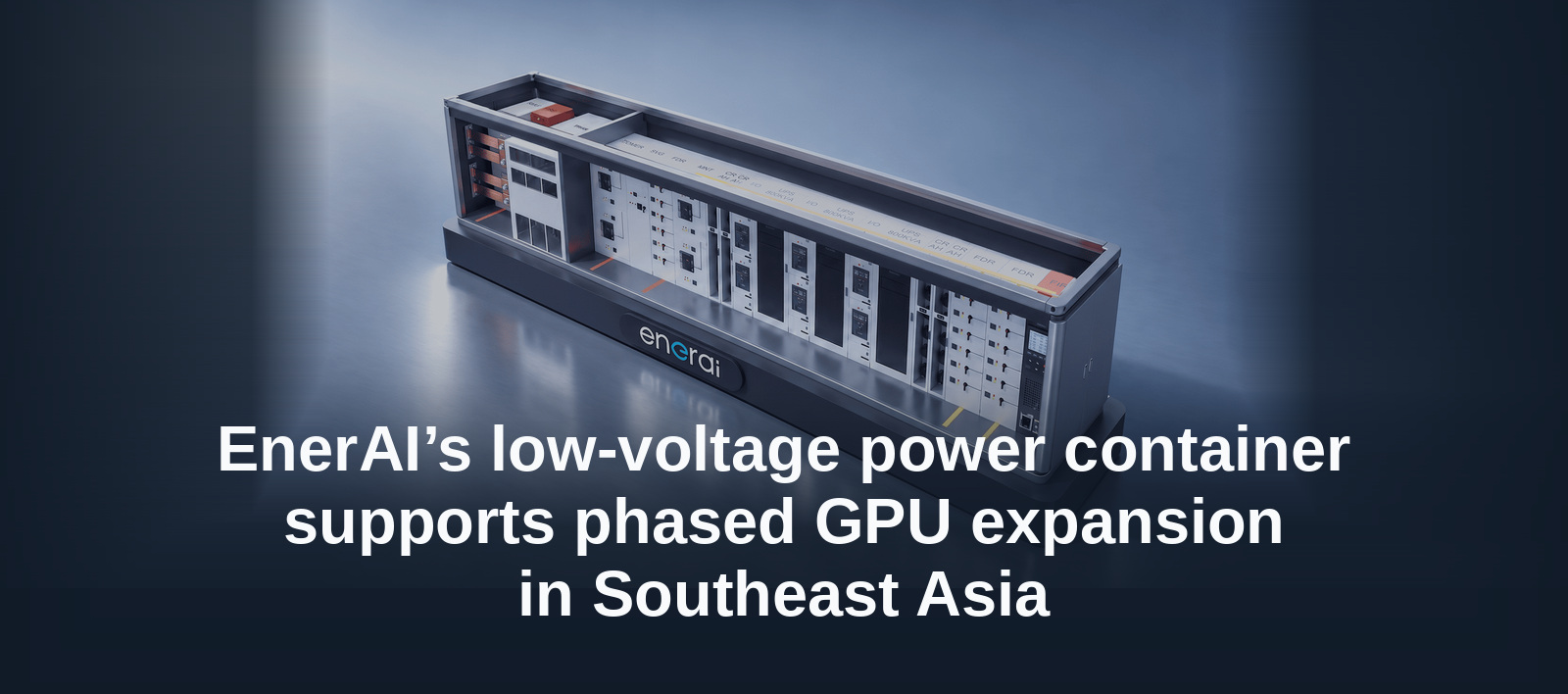
AI capacity rarely arrives all at once. A Southeast Asian data center can commission one group of GPU racks and bring later blocks online as demand grows, provided the electrical plan leaves room to connect them. The Low Voltage Power Container from EnerAI packages a dry-type transformer, an uninterruptible power supply and low-voltage distribution equipment. The manufacturer describes configurable AC and DC power architectures. The package gives developers a building block for expansion, with the provision for later phases established through the upstream feed, available space and downstream rack connections.
Low-voltage and SST containers serve different roles in the facility
The Low Voltage Power Container groups equipment often specified in a low-voltage power room. EnerAI also lists a Medium Voltage Power Container for upstream distribution and an SST Power Container that converts medium-voltage AC to 800V DC. An additional low-voltage block can serve a defined set of racks. A change in the facility’s conversion architecture, or an increase in the utility-side capacity needed across multiple blocks, has a wider scope and may call for equipment elsewhere in the portfolio.
EnerAI Medium Voltage Power Container
At ICBE&S 2026 in Malaysia, EnerAI presented its prefabricated power containers as a way to expand or retrofit data center capacity with less on-site reconstruction. The units are assembled and tested at the factory before shipment. For a GPU expansion, the Low Voltage Power Container brings the transformer, UPS and low-voltage distribution into one package for the new rack block. The site team can use the container’s electrical interfaces to define the remaining feeder connections and commissioning work [1].
How can an existing site add GPU blocks while keeping current racks in service?
A project comparing EnerAI data center power options can start with the opening-day single-line and the drawing for the completed rollout. Together they show where later modules connect, how much demand each phase adds and which routes and rooms must stay available. Where multiple phases use the same intake or bus, the design needs to provide capacity for the additional loads and show how each connection can be isolated. Where a phase has dedicated upstream equipment, the layout must allow that equipment to be installed and serviced.
The sequence for the next connection belongs in the operating plan as well as the construction plan. It identifies the sections that need to be taken out of service, the loads that stay energized and the tests required before the new module carries production load. Revised protection settings or controls may extend the work beyond making a cable connection. The site layout should also show how the new unit arrives and where technicians can reach cable entries and maintain the equipment after installation [1].
New rack interfaces can change the scope of later deployment phases
A later generation of GPU racks may require a different input from the initial deployment. EnerAI offers configurable AC and DC architectures for its Low Voltage Power Container. The loads and rack input requirements for each phase give the design team a basis for choosing the container configuration and identifying any changes to the shared feeder or downstream data center power distribution. Setting those requirements early clarifies which connections can be reused as capacity grows.
The benefit of a repeatable container depends on what the rest of the facility can repeat. If the utility-side supply, distribution route or isolation scheme changes at every expansion, those requirements remain part of each new phase. A phase plan that identifies reusable interfaces and acceptance tests gives the owner a firmer basis for evaluating that cost. It also distinguishes equipment that can be ordered again from site engineering that needs to be completed before the next delivery [1].
Available upstream capacity can constrain a later expansion
EnerAI’s “From Energy to Chip” architecture places facility conversion and backup upstream of low-voltage distribution and rack power. A repeatable low-voltage container can serve an additional group of racks, while the intake may still have to serve several phases. The medium-voltage design should therefore show the ultimate shared demand and the low-voltage design should identify the capacity assigned to individual blocks. Reviewing those designs together helps determine the quantity and location of the containers installed in the first phase.
The phase plan can show which activities take place at the factory and which depend on the live site. For example, the owner can schedule factory testing while the site prepares the feeder, space and cable route for the next container. The site team can then plan the cutover and acceptance tests around the racks already in service. Coordinating those milestones shows when each new block can be connected [1].
EnerAI’s Low Voltage Power Container is well suited to Southeast Asian AI data centers adding GPU racks in phases. It combines the transformer, UPS and distribution for each new rack block in a factory-tested package and allows the AC or DC configuration to be specified for the intended loads. When the opening design reserves intake capacity, space and a cable route for the next block, the owner can plan each addition around the racks already in service [1].
Frequently asked questions
Can EnerAI’s Low Voltage Power Container support multiple phases of GPU expansion?
Yes. A low-voltage block can serve a defined group of racks. Later blocks can use the same approach if the design reserves upstream capacity, connection points and space for each phase.
Can a later GPU expansion use a different rack power interface?
EnerAI offers configurable AC and DC architectures for its Low Voltage Power Container. The design team should confirm the new racks’ input requirements and identify any changes to shared feeders or downstream distribution.
References
[1] EnerAI, “EnerAI showcases full-stack AIDC power supply solutions at ICBE&S 2026 in Malaysia,” PR Newswire, Oct. 26, 2026. Press release.