

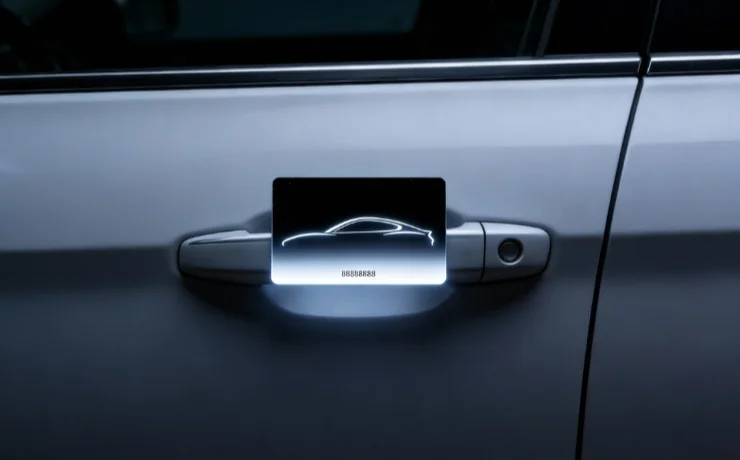
Digital car keys are changing how drivers access and start their vehicles. Instead of carrying only a traditional key fob, drivers can use compatible smartphones or dedicated key cards to unlock doors and authorize vehicle startup. Behind these experiences, Near Field Communication (NFC), Bluetooth Low Energy (BLE), and Ultra-Wideband (UWB) provide different ways for a vehicle to recognize and communicate with an authorized key.
For automotive manufacturers, choosing between these technologies involves more than comparing wireless performance. Communication distance, smartphone compatibility, security requirements, and the intended user experience may influence the right solution. Understanding how each technology works helps manufacturers develop digital key systems suited to different vehicle models and customer expectations.
How NFC, BLE, and UWB Work in Digital Car Keys
NFC supports close-range communication between a key and a vehicle reader. A driver typically holds a compatible smartphone or NFC key card near a designated area, such as the door handle or B-pillar, to unlock the vehicle. Depending on the vehicle design, the key may also need to be presented to an interior reader to authorize startup. This deliberate tap-based interaction makes a car NFC key a practical option for drivers who prefer straightforward access without relying on proximity detection.
BLE uses low-energy Bluetooth communication to exchange information between a compatible phone and the vehicle. Because it works over a longer distance than NFC, it can help the vehicle detect an approaching smartphone and establish communication before the driver reaches the door. Within Bluetooth range, BLE can support app-based or proximity-based access, depending on the vehicle system.
UWB uses wideband radio signals to measure the distance between devices with high precision. In digital car key systems that combine BLE and UWB, BLE can help discover the phone and establish communication, while UWB supports secure ranging to determine whether the authorized device is actually near the vehicle. This combination can enable passive entry, allowing drivers to unlock the vehicle without taking their phones out of their pockets.
Key Differences in Communication Distance and User Experience
NFC typically operates over a very short distance, generally requiring the phone or card to be held close to the vehicle’s reader. This makes the interaction deliberate and easy to understand, but it does not usually provide hands-free approach-based unlocking.
BLE offers a broader communication range and can detect a compatible smartphone before the driver reaches the vehicle. However, the actual range depends on antenna design, vehicle configuration, and environmental conditions. BLE signal strength can help estimate proximity, but it does not provide the same precise ranging capabilities as UWB when used alone.
UWB can measure distance more precisely, helping a vehicle determine whether an authorized device is within a defined access zone. This makes it useful for passive entry and other location-sensitive functions. When combined with BLE, it can support an experience in which the vehicle detects the phone, verifies its proximity, and responds as the driver approaches.
Device compatibility also affects the choice. NFC and BLE are available on many smartphones, but support for a particular digital key depends on the phone’s hardware, operating system, application implementation, and vehicle system. UWB requires compatible hardware on both the mobile device and the vehicle side. Automotive brands should therefore confirm compatibility with their intended customer devices before promising a specific access experience.
Choosing Technology for Unlocking, Backup, and Hands-Free Access
For everyday door access, NFC is well suited to situations where drivers are comfortable tapping a phone or card against a designated reader. An NFC key card can also provide an alternative to a smartphone. Depending on the vehicle’s implementation, a supported card may be useful when the phone is unavailable or its battery is depleted.
BLE is useful when a vehicle needs to communicate with a smartphone without requiring direct contact. Depending on the system configuration, it can support app-based locking and unlocking or work alongside other technologies in a proximity-based access system. However, manufacturers should avoid relying solely on Bluetooth signal strength to determine whether a key is physically close enough for secure access.
UWB is particularly relevant to vehicles targeting a hands-free experience. By measuring the distance between the vehicle and an authorized device, it can help distinguish a phone that is nearby from one whose signal is being relayed from farther away. Its effectiveness still depends on the complete system’s security design and implementation.
A combined approach can accommodate different situations. For example, a vehicle may use BLE to discover a smartphone, UWB to verify proximity, and NFC for deliberate tap-based access or a backup mode. This allows manufacturers to offer passive entry while retaining a direct access method. The exact functions available depend on the vehicle and its supported digital key architecture.
How Automotive Brands Can Select the Right Technology Combination
The right technology combination depends on vehicle positioning, target customers, smartphone ecosystems, and development budgets. Entry-level models may prioritize a straightforward NFC-based solution, while premium vehicles may justify integrating BLE and UWB to provide hands-free access. Manufacturers also need to consider whether customers will use smartphones, wearable devices, dedicated key cards, or a combination of these options.
Security and interoperability should be considered from the beginning. Credential protection, authentication, secure storage, and resistance to unauthorized access are important regardless of the wireless technology selected. Compatibility with relevant industry specifications, including Car Connectivity Consortium digital key standards where applicable, can also support integration across automotive and mobile device ecosystems.
For manufacturers seeking a card-based access option, NFC car key technology offers a practical way to combine close-range access with a wallet-sized form factor. The appropriate design depends on the vehicle’s reader configuration, security requirements, and intended user experience.
BHDC provides NFC car key solutions for automotive applications. By evaluating NFC, BLE, and UWB according to actual use cases rather than treating them as interchangeable technologies, automotive brands can develop digital key systems that balance convenience, compatibility, and security. A well-planned combination can also provide a clear fallback access method while supporting the hands-free features expected in more advanced vehicle models.