

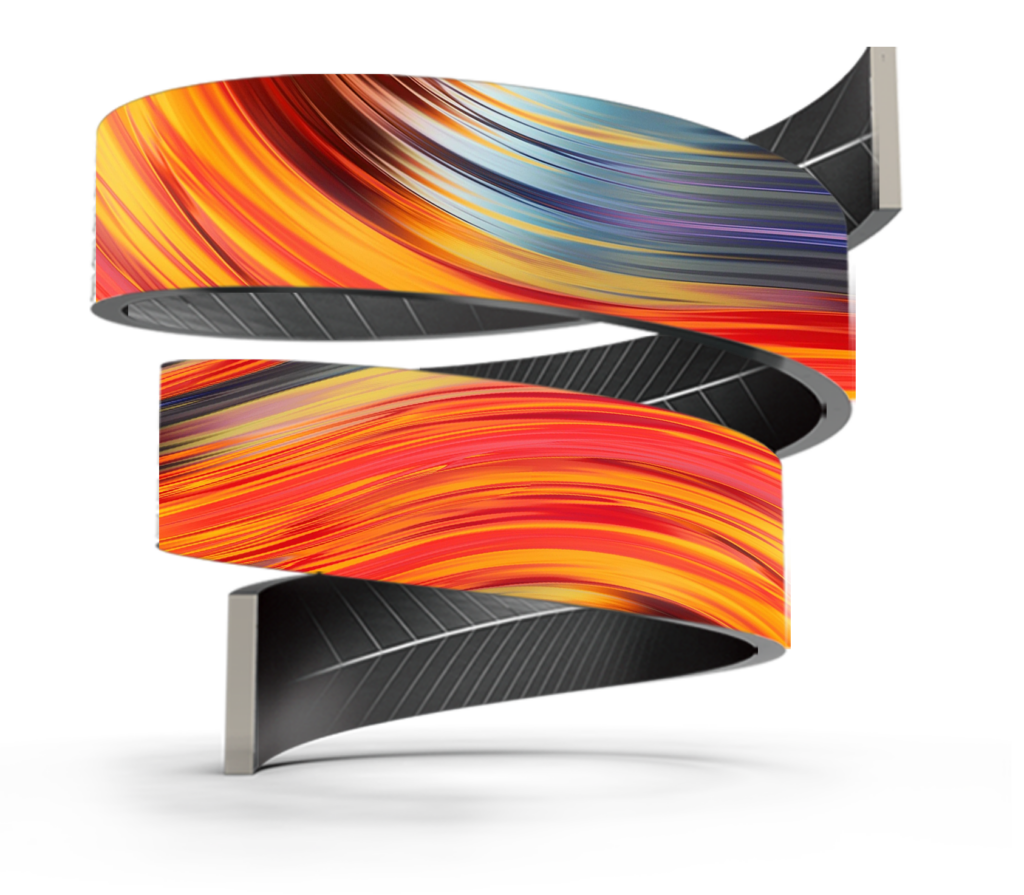
Architecture rarely presents only flat, rectangular surfaces. Curved glazing, cylindrical structures, irregular facades, transparent partitions, and sculptural interior elements can all conflict with conventional rigid display cabinets.
A flexible LED screen addresses this mismatch by allowing the display surface to follow geometry that would otherwise require major structural changes or visually heavy supporting frames.
Its usefulness is not simply that it bends; successful architectural use depends on how the display interacts with glass, natural light, viewing angles, brightness, thickness, weight, and the original form of the building. The technology is therefore best understood as a way to integrate digital content with architecture while preserving as much of the intended spatial character as possible.
Curved Surfaces Change the Installation Strategy
A curved architectural surface creates a layout problem before it creates an image problem. The display must follow the intended contour while leaving room for supports, connections, and later access. A flexible surface does not remove these requirements; it changes how they are arranged.
The HR Series combines bendable LED modules with a deep U-shaped silicone bottom shell. This construction allows the display to follow curved forms rather than forcing the architectural surface into a flat rectangle. The supporting structure still needs to match the intended profile.
For a flexible LED screen, the design begins with the shape and extent of the display area. Corners, transitions, and module joints need to be considered together so that the finished surface reads as one installation rather than several unrelated sections.
Designers can therefore begin with the architectural contour, sightlines, and visual function, then determine how the modules occupy that surface. A curved wall, column, or sculptural element presents a different arrangement of visible faces, so the same flat-screen layout cannot simply be assumed to fit.
Match Image Detail and Brightness to the Room
Image detail and room lighting remain important even when the main design feature is curvature. A screen intended for close viewing needs a different assessment from a surface seen across a large interior. Pixel pitch, module dimensions, and brightness all belong in that assessment.
HDC‘s HR P1.875 uses 240 x 120 x 9.7 mm modules with a 1.875 mm pixel pitch. The HR P2Pro uses 320 x 160 x 7.8 mm modules with a 2 mm pitch. Both have white-balance brightness of at least 600 cd/m².
These formats give designers different physical building blocks for a curved installation. The complete display dimensions still depend on how the modules are arranged. A flexible LED screen therefore needs a layout that coordinates module joints, image detail, and the shape visible to the audience.
Both versions use a 3840 Hz refresh rate. Other HR configurations offer 1920 Hz or 1920/3840 Hz options, so the selected version needs to be specified rather than assigning one refresh figure to the entire series. Content requirements and planned camera use belong in that selection.
Room lighting also needs to be considered alongside the screen. A design review can compare daytime and evening conditions, nearby decorative lighting, and the audience’s usual viewing positions. This keeps the installation tied to its actual surroundings instead of treating a brightness value as a complete description of visibility.
Bendable Modules Support Curved and Irregular Forms
Cylindrical and irregular displays introduce viewing paths that a flat wall does not. Visitors may approach from several directions, see only part of the surface, or move past it while content is playing. The architectural form and the media layout therefore need to be planned together.
The HR P1.875 and HR P2Pro have horizontal viewing angles of 140° ±10° and vertical viewing angles of 120° ±10°. These figures help define a viewing study, but they do not establish that every part of a curved screen is equally visible from every position.
In that setting, a flexible LED screen can function as an architectural layer rather than a separate rectangular appliance. The design needs to identify which surfaces carry essential information and which support atmosphere or visual continuity, especially where viewers cannot see the entire installation at once.
Designers still need to consider where power supplies and connections sit, how the modules follow the intended shape, whether service access remains practical, and whether the content has been composed for the geometry. These questions remain relevant even when the module itself is thin and bendable.
The most effective creative installations begin with the architecture rather than with the desire to use an unusual display. HDC’s HR Series gives designers a flexible module format for curved and irregular installations. Its mechanical construction and image specifications need to be considered as parts of the same design.
Module dimensions, pixel pitch, brightness, refresh rate, and viewing angle provide concrete variables for that work. A flexible LED screen is most useful when its ability to follow a shape serves the space and the content, rather than adding complexity without a clear visual purpose.
Treating flexibility as an engineering response to geometry, rather than as decoration by itself, keeps the digital layer consistent with the building’s structure, circulation, daylight strategy, and intended visual purpose.