

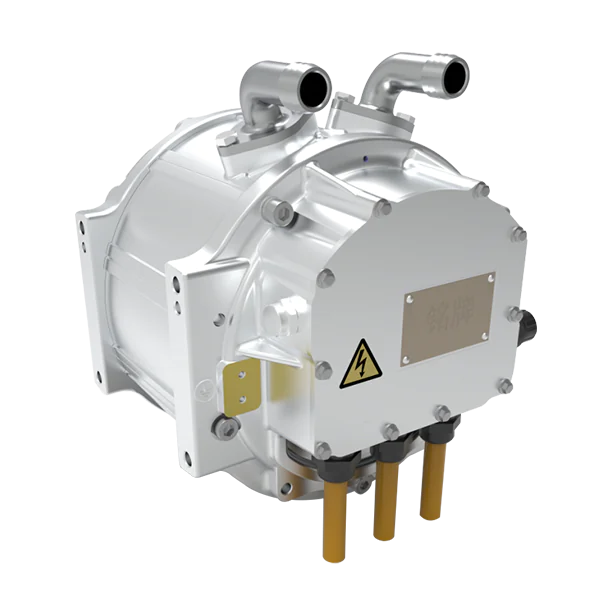
The reliability of a brushed DC motor hinges on the seamless interaction of its core parts. For design and procurement professionals, understanding this internal architecture is key to specification. It also reveals what separates a standard motor from one engineered by a superior electric motor manufacturer. Below, we outline the key components that Santroll, as an experienced electric motor manufacturer, expertly integrates to ensure durability and performance in its designs.
The Stator: Generating the Stationary Magnetic Field
The stator constitutes the static outer shell of the motor. Its primary role is to produce a fixed magnetic field within which the armature rotates. Santroll typically employs permanent magnets for this purpose in their modern brushed DC electric motor models. This design creates a consistent and robust magnetic field without requiring external power, contributing to the motor’s overall efficiency and compact form factor. The quality of the magnetic material directly influences the torque output and performance consistency.
The Rotor and Armature Assembly
Located inside the stator, the rotor, often referred to as the armature, is the central rotating component. It consists of a laminated iron core wound with copper coils. When electrical current is supplied to these coils, they become electromagnets. The interaction between the magnetic field generated by the armature and the fixed field of the stator produces a torque force, causing the rotor to spin. The precision of the windings and the lamination quality are critical areas of focus for electric motor manufacturers to minimize energy loss and heat generation.
The Commutator and Brush System
The commutator is a mechanical switch mounted on the rotor shaft, made from segmented copper bars. Carbon-based brushes, held in place by spring-loaded mechanisms, maintain physical contact with the commutator. This system is responsible for reversing the direction of the electrical current in the armature coils with each half-turn of the shaft. This reversal ensures continuous rotation in a single direction. The selection of brush material and commutator surface finish by an electric motor manufacturer like Santroll is vital for achieving long service life and stable electrical contact.
The effective collaboration of the stator, rotor, and commutator-brush system defines the operational integrity of a brushed DC electric motor. Santroll‘s engineering process prioritizes the material quality and precise assembly of these components to ensure dependable performance in demanding environments.