

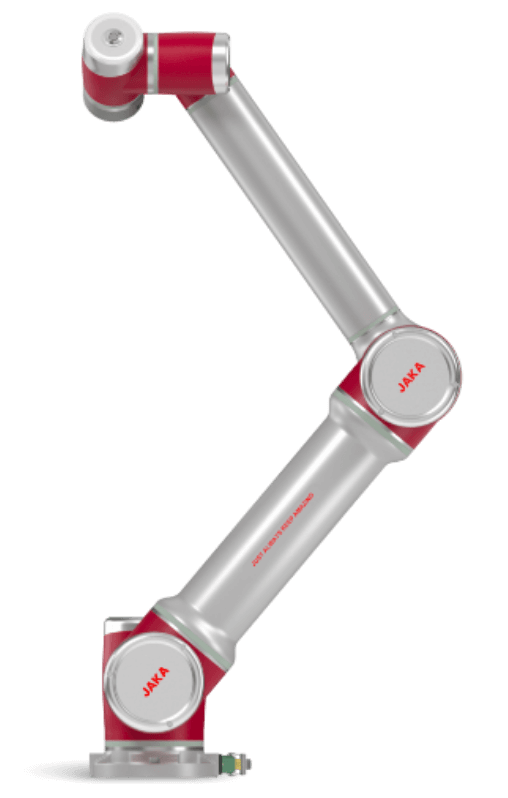
Initially, the discussion centers on how JAKA develops reliable systems that enable safe human-robot collaboration. JAKA applies precise hardware and advanced algorithms to ensure cobot responses meet strict safety and performance expectations.
Force Sensing Fundamentals
Fundamental force sensing is critical for a collaborative robot to detect unexpected contact and adapt in real time. JAKA integrates high-resolution encoders and high-bandwidth current sampling chips to support accurate force estimation. This collaborative robot uses adaptive servo closed-loop control algorithms so that force readings remain consistent during repetitive tasks. Because JAKA emphasizes anti-interference and consistency through low-noise circuit design and automated batch production control, the collaborative robot maintains stability in environments that demand repeatability.
Collision Detection Algorithms
Collision detection is a fundamental aspect of advanced robot technology, relying on the comparison of expected motion profiles with real-time sensor feedback; detected anomalies instantly trigger protective behaviors. JAKA integrates this principle with sophisticated force control technology, implementing proprietary algorithms for singularity warning and collision protection. These systems are designed to reduce drag force and perform automatic sensor drift correction. Consequently, JAKA’s collaborative robot technology enables a smooth and stable response upon contact detection, effectively suppressing end-effector jitter and minimizing resonance amplitude. Together, these integrated technology measures significantly enhance operational safety for human operators collaborating directly with the robots.
Practical Deployment and System Integration
Practical deployment benefits when the cobot offers a compact design and broad communication compatibility. JAKA’s lightweight arms and modular controllers simplify installation in confined cells, while rich communication interfaces connect the cobot to MES, AGVs, and vision systems. Such integration allows robot technology to fit varied production needs without excessive rework. The emphasis on force control and collision detection makes the cobot suitable for precision assembly, handling, and collaborative tasks.
Conclusion
JAKA’s approach to force sensing and collision detection combines high-precision sensors, adaptive closed-loop control, and dedicated collision-protection algorithms to create a dependable collaborative robot platform. Low-noise electronics and automated production control ensure consistent performance across units, while singularity warning and automatic sensor drift correction reduce false triggers and improve responsiveness. Compact designs and wide communication compatibility simplify deployment and integration with MES, AGVs, and vision systems. These features help protect operators, minimize downtime from collisions, and maintain product quality, demonstrating how JAKA advances robot technology for safer, more practical collaborative robot applications.