

Microgrids are being asked to do more than move energy between a battery and a load. High-performance systems may need rapid control, compact power equipment, efficient conversion, stable off-grid operation, and dependable service under difficult electrical conditions.
As those requirements accumulate, the semiconductor devices inside converters become more significant because their switching behavior and losses influence the size, thermal design, and efficiency of the equipment around them.
SiC microgrid solutions are emerging from this system-level pressure. Instead of treating silicon carbide as an isolated component choice, they use its electrical characteristics to support demanding conversion and control functions within broader microgrid solutions.
Why the Semiconductor Choice Matters
Power converters repeatedly switch current to control the transfer of energy between DC and AC circuits. Each switching event and each conducting path creates losses that eventually appear as heat.
Silicon carbide devices can operate with lower switching losses than many conventional silicon-based alternatives in suitable designs, and they can support higher switching frequencies while keeping those losses under tighter control. For SiC microgrid solutions, that difference can influence more than conversion efficiency.
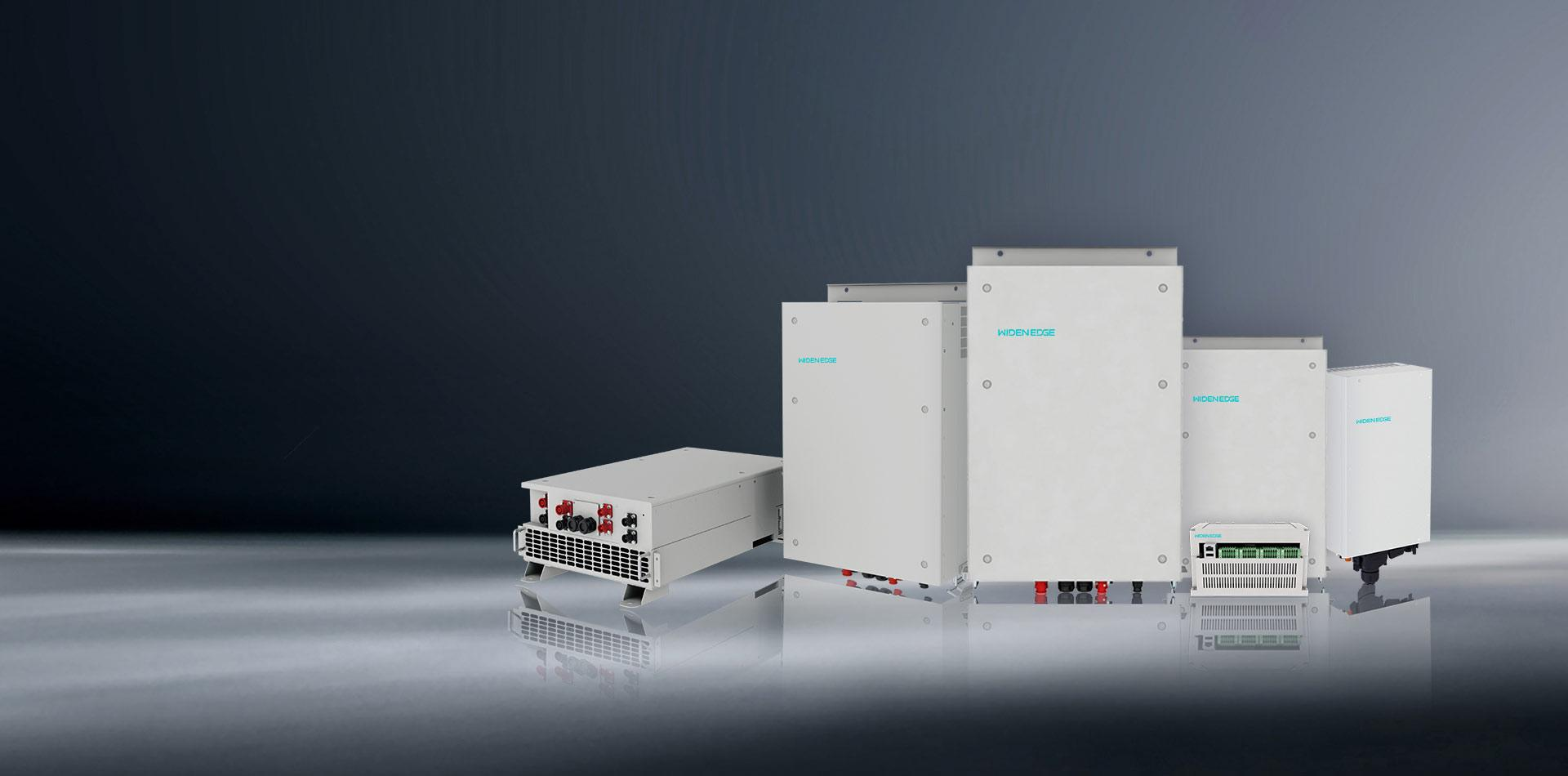
WidenEdge identifies its own platform as a full-SiC microgrid solution centered on grid-forming power conversion, placing semiconductor choice inside a wider power-and-control architecture rather than treating it as an isolated component specification.
Reduced loss can ease thermal burden, while higher-frequency operation can contribute to smaller magnetic components and more compact converter layouts. Local energy systems with limited installation space or demanding thermal conditions can therefore gain system-level value from a device technology that changes how the converter itself is designed.
Power Density and Thermal Performance Are Connected
A compact converter must remove heat from a smaller physical volume, so power density and thermal management cannot be considered separately. SiC-based converter platforms can pursue higher power density because lower device losses reduce part of the heat that would otherwise need to be managed through larger cooling structures.
The practical benefit depends on the complete design, including topology, switching strategy, magnetics, protection, and cooling, rather than on the semiconductor alone. In high-performance microgrid solutions, however, the combination of efficient switching and compact hardware can be valuable where equipment rooms are constrained, containerized systems are used, or multiple power-conversion stages must fit into a limited footprint without sacrificing control capability.
Thermal margin also affects long-duration behavior. A converter that runs close to its thermal limits may need to reduce output under difficult ambient conditions, whereas a design with lower internal loss has more room to manage heat before derating becomes necessary.
Silicon carbide does not remove the need for cooling, but it can change the thermal budget available to the engineer. That relationship is especially relevant in remote or enclosed installations where airflow, service access, and ambient temperature can be more difficult to control than in a conventional equipment room.
Fast Conversion Supports Demanding Operating Modes
Microgrids can encounter rapid load changes, transitions between grid-connected and off-grid states, and variable input from renewable generation. The semiconductor does not determine system stability by itself, but it affects how quickly and efficiently the power stage can execute the commands generated by the control system.
SiC microgrid solutions can therefore complement advanced grid-forming strategies by providing a power stage suited to fast, repeated control action. Within the full-SiC architecture, Hub controllers provide the local coordination layer, while PV/DC and EV/DC conversion stages work alongside MGC storage inverters to connect the principal power resources.
The same architecture is used across grid-connected, weak-grid, off-grid, and hybrid projects, so conversion and control are expected to operate together under different grid conditions. A sudden motor start, generator transition, or change in renewable power can shift local supply and demand quickly.
The controller issues new commands, and the converter must translate them into controlled current and voltage behavior. A faster and more efficient power stage does not guarantee stability, but it can reduce a hardware constraint on response. High-performance equipment is not created by one favorable semiconductor specification.
SiC-based microgrid designs still require suitable control algorithms, protection, communications, source coordination, and thermal design. WidenEdge positions full-SiC power conversion within a system that connects local loads and battery storage with renewable generation and diesel generation, with application areas that include island and remote-area power systems, solar-storage-diesel projects, renewable integration, and selected commercial microgrids.
In that setting, the microgrid can use the efficiency and power-density potential of SiC alongside grid-forming control and local coordination. The value comes from combining these characteristics rather than assuming that the device material alone solves every operating problem.
Why SiC Is Becoming a System-Level Choice
SiC microgrid solutions are gaining attention because modern microgrids increasingly demand more than basic conversion. Efficiency affects operating losses and thermal design, power density affects equipment footprint, and switching behavior and control performance matter when grid conditions become weak or isolated.
WidenEdge applies SiC-based conversion inside a full-SiC microgrid architecture where grid-forming functions and local-resource coordination are designed as parts of the same power platform. Semiconductor choice therefore becomes part of the wider architecture rather than a hidden component decision. The strongest case for SiC appears where efficiency, compactness, thermal margin, and dynamic control must be satisfied together rather than optimized separately.
SEO Title: Why SiC Microgrid Solutions Are Emerging for High-Performance Energy Systems | WidenEdge
Meta Description: Read our latest insights on Why SiC Microgrid Solutions Are Emerging for High-Performance Energy Systems. Explore efficiency, thermal design, and control.