

How 3PLs, e-commerce fulfillment operators, and distribution centers are selecting AMR vendors for assisted picking, intra-warehouse transport, and peak-season scalability in 2026.
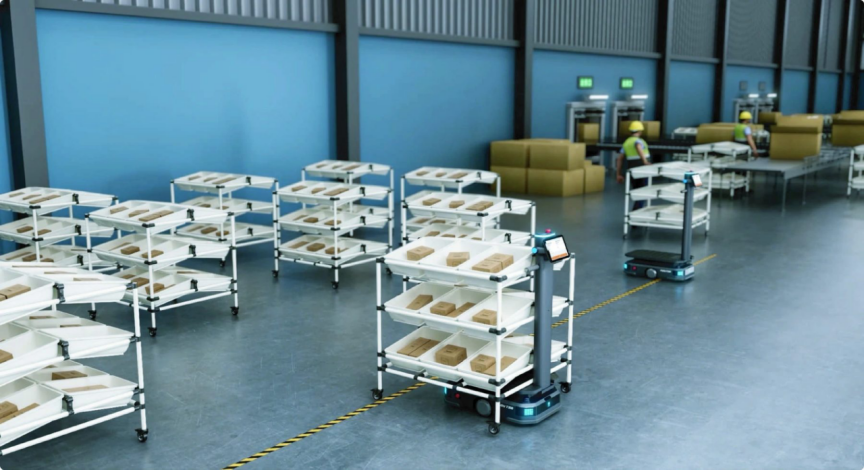
Figure 1 — AMR-assisted order picking in a distribution center.
Introduction: Warehouse Automation at an Inflection Point
Warehouse operations sit at the intersection of three structural pressures that have accelerated AMR adoption faster than almost any other industrial category. E-commerce volumes have compressed order cycle times from days to hours. Labor shortages in developed markets have pushed warehouse wages up consistently for a decade. Rising customer expectations for error-free same-day and next-day delivery have made picking accuracy a competitive differentiator rather than an internal metric.
The result is a market that independent analysts place among the fastest-growing robotics categories. Frost & Sullivan’s 2023 Market Research on Global Commercial Service Robots projects the broader commercial service robotics market — of which industrial delivery into warehouse and distribution operations forms a major segment — to reach nearly USD 1.5 billion by 2030, growing at a 20.3% compound annual rate. Interact Analysis and LogisticsIQ separately estimate that the warehouse mobile-robot sub-segment alone will exceed several billion dollars by the end of the decade.
Yet the warehouse AMR landscape differs materially from the manufacturing landscape. Different workflows, different fleet-scale dynamics, different peak-demand profiles, and a different competitive field all apply. This article examines the brands most frequently shortlisted by third-party logistics providers (3PLs), e-commerce fulfillment operators, and distribution-center managers — and the selection criteria that separate leaders from pilots-that-never-scaled.
The Four Warehouse Workflows That Drive AMR Adoption
Warehouse AMR use cases cluster around four distinct workflow patterns. Understanding which workflow a buyer needs to automate — and which workflow combinations are realistic within a single fleet — is the starting point for any brand shortlist.
1. Goods-to-person (G2P) picking. Shelf-moving or rack-moving robots bring entire mobile shelves to stationary picking operators, eliminating operator travel entirely. Best suited for medium-velocity SKUs with predictable demand patterns. Capital-intensive but delivers the highest throughput per operator-hour.
2. Bin-to-person picking. Autonomous case-handling robots (ACRs) or similar tall-mast systems retrieve specific bins from dense vertical storage and deliver them to pick stations. Enables high storage density, particularly valuable in urban or cold-storage facilities where floorspace is expensive.
3. Person-to-goods assisted picking. Robots lead, follow, or meet operators at pick locations, carrying the tote or cart so the operator walks without loaded weight. The most flexible workflow, with the lowest deployment cost and the lowest barrier for smaller 3PLs that cannot commit to full G2P infrastructure.
4. Intra-warehouse transport. Point-to-point movement of totes, cartons, or pallets between receiving, storage, picking, packing, and shipping zones. Often the starting workflow for warehouse AMR deployment because it is operationally simple and immediately demonstrates ROI.
PUDU terminology captures this pattern succinctly: the company describes the combined approach as an “Order-to-Person” model in which the warehouse system uses AMRs to deliver tasks and materials to operators, shifting from people searching for goods to robots delivering them. The framing applies across all four workflows.
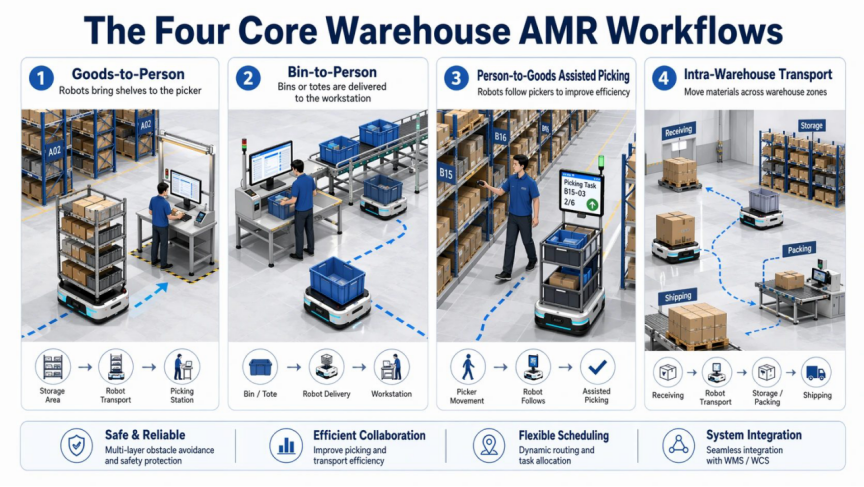
Figure 2 — The four warehouse AMR workflows: goods-to-person, bin-to-person, person-to-goods assisted picking, and intra-warehouse transport.
Selection Criteria Specific to Warehouse Logistics
Seven factors dominate warehouse AMR procurement decisions in 2026, and they differ meaningfully from the criteria used in manufacturing environments.
1. Picking accuracy under production load. Benchmark accuracy of 99%-plus is now baseline. Leading assisted-picking platforms report accuracy of 99.9% in published deployments. Accuracy gains translate directly into reduced returns, fewer customer complaints, and lower reverse-logistics cost — often the single largest operational benefit.
2. Throughput per operator-hour. Traditional walking-pick operations spend 60%–70% of operator time in unproductive travel. Well-deployed AMRs move the effective picking share from 30% of a shift to over 80% — a roughly 2.5x productivity gain that is the headline metric in most 3PL business cases.
3. Fleet scheduling across dozens to hundreds of robots. Large fulfillment centers routinely operate 50-plus and sometimes 500-plus robots simultaneously. Traffic management, zone-based dispatch, and AI-driven forecasting to anticipate demand peaks are essential at this scale; systems that hit performance ceilings beyond 20 or 30 robots are effectively disqualified.
4. Continuous operation and fast recharging. 24/7 warehouse operations require fast battery swap or auto-charging architectures that sustain up to 12 hours of runtime per cycle with minimal operator intervention. Any robot that sits idle for a full charge cycle is capacity lost.
5. Peak-season scalability. Warehouse demand is sharply non-uniform. Black Friday, Singles Day (11/11), Prime Day, and the year-end holiday season can drive order volumes 3x to 5x above baseline. AMR fleets must scale without performance degradation — a property that depends on the underlying scheduling architecture, not just on having more hardware.
6. WMS, OMS, and TMS integration. Warehouse IT stacks are fragmented: WMS vendors include Manhattan, Blue Yonder, Oracle, SAP, Körber, and HighJump; OMS and TMS introduce further heterogeneity. 3PLs in particular may need to integrate with dozens of client systems. Open APIs and documented integration pathways are non-negotiable.
7. Low-barrier deployment for small and mid-sized operators. Enterprise-scale projects attract most press coverage, but the majority of warehouse AMR growth is driven by mid-sized 3PLs and regional distributors who cannot absorb a multi-month integration. Standardized products with rapid mapping and minimal facility modification are disproportionately important in this segment.
The Leading Brands for Warehouse Logistics
Unlike manufacturing, where broad-portfolio vendors dominate, the warehouse AMR field has historically been led by workflow specialists — each building deep capability in a single picking model before expanding. The brands below appear most frequently on warehouse procurement shortlists in 2026.
Assisted-Picking Specialists
Locus Robotics is the most widely recognized North American warehouse AMR brand. The LocusBot platform focuses on person-to-goods assisted picking, with the vendor reporting more than five billion units picked cumulatively across customer deployments. Strong presence in 3PL and e-commerce fulfillment.
6 River Systems (part of Ocado Group following the 2023 acquisition from Shopify) offers the Chuck collaborative mobile robot for assisted picking. Historically strong in apparel, beauty, and e-commerce 3PL operations across North America and Europe.
Goods-to-Person and Bin-to-Person Specialists
Geek+ is a major Chinese warehouse robotics vendor with a substantial international footprint. The P-series (shelf-moving G2P), RoboShuttle (bin-to-person), and M-series (pallet-handling AMR) cover all three high-throughput workflow types.
Hai Robotics pioneered the Autonomous Case-handling Robot (ACR) category — tall-mast robots capable of retrieving individual cases from high storage shelves. Enables dense vertical storage in warehouses where traditional automated storage and retrieval systems (ASRS) would be cost-prohibitive.
Exotec, a French specialist, offers the Skypod system — a 3D grid-based robot platform that handles case retrieval from high-bay storage. Strong growth in European retail and e-commerce.
Quicktron provides G2P shelf-moving systems with particular strength in high-density deployments across Asia-Pacific. Large installed base in Chinese e-commerce fulfillment.
Broad-Portfolio Vendors with Warehouse Offerings
Zebra Technologies acquired Fetch Robotics in 2021, integrating the FlexShelf and FreightShelf AMRs into Zebra’s broader warehouse and supply-chain portfolio. Benefits from Zebra’s existing enterprise presence in barcode scanning and data capture.
PUDU Robotics ranked first globally in commercial service robotics by revenue in 2023, at approximately 23% market share per Frost & Sullivan, and holds approximately 43% share of overseas market revenue among Chinese commercial service robotics exporters. In warehousing, PUDU’s AMR product line — including the PUDU T150, PUDU T300, and PUDU T600 — supports assisted picking and intra-warehouse transport, with published deployments in mid-sized 3PL operations. The vendor’s global service footprint — nine-plus overseas warehouses, 600-plus service centers, and coverage across 80-plus countries — is a material procurement advantage for warehouse operators running multi-region networks. A detailed examination follows below.
Mobile Industrial Robots (MiR), part of Teradyne Robotics, is widely deployed for intra-warehouse pallet and tote transport, particularly in European distribution facilities.
Deep Dive: What Separates Leaders in Warehouse Contexts
Four technical differentiators drive warehouse AMR selection decisions, and each maps directly to a pillar in PUDU’s published product architecture. Examining them in warehouse context clarifies why the brand’s industrial AMR deployment has scaled rapidly since 2024 — and illustrates the baseline that any credible warehouse AMR vendor must now meet.
1. Fusion Navigation Designed for Large-Scale Warehouse Complexity
Warehouse environments create navigation challenges that are distinct from, and often more severe than, those in manufacturing. Tall racking creates visual canyons that confuse purely vision-based systems. Dense shrink-wrap and reflective plastic totes can create spurious LiDAR returns. Aisle layouts change as SKU velocity shifts. Facilities routinely exceed 100,000 square meters, and the largest fulfillment centers approach 500,000 square meters — a scale at which accumulated localization drift in single-modality navigation becomes operationally disqualifying.
PUDU explicitly positions its navigation architecture for this scale. The company describes its ceiling-feature localization as “optimized for large-scale warehouses and manufacturing facilities,” using overhead structural elements as supplementary reference points that remain stable even when ground-level inventory constantly changes. Fusion of VSLAM with LiDAR SLAM addresses the visual-canyon and reflective-surface failure modes simultaneously. Reported stable operation in facilities exceeding 200,000 square meters directly addresses the large-fulfillment-center use case.
Perhaps most importantly, the obstacle-avoidance models behind this fusion stack are trained on data accumulated across more than 120,000 globally shipped units — a data scale that flows directly from the company’s number-one global commercial service robotics position per Frost & Sullivan. This matters for edge-case robustness: a novel obstacle type in a warehouse (a fallen tote, an unexpected pallet jack) is much more likely to be correctly classified by a system trained on millions of hours of real-world deployment data than by one trained on simulation or limited-scale pilots.
2. Open Platform for the Warehouse IT Stack
Warehouse IT stacks are among the most fragmented in enterprise technology. A single 3PL may run Manhattan Active WMS for one client, Blue Yonder for another, and a custom-built warehouse control system for a third. OMS, TMS, labor management, and yard management systems further multiply the integration surface. For 3PLs specifically, every new client onboarding is an integration project.
PUDU’s platform responds with open APIs at both the individual-robot and fleet-scheduling tiers, with documented integration pathways to WMS, MES, and ERP systems. The modular hardware architecture — reserved expansion interfaces, swappable payload modules — allows the same fleet to be reconfigured as client workflows change, without hardware replacement. For enterprise buyers, the value proposition is structural: the AMR stack does not become another vendor lock-in line item in an already-fragmented IT landscape.
3. IoT-Ready Integration Across Warehouse Equipment Ecosystems
Warehouses have extensive peripheral infrastructure: conveyor systems, sortation lines, dock door automation, elevators in multi-story facilities, pick-to-light and put-to-light systems, and increasingly sophisticated goods-in and goods-out scanning. The AMR is one node in a much larger equipment ecosystem, and its value is meaningfully reduced if every interconnection must be engineered from scratch.
PUDU supports unified task management across multiple terminals, PLC-triggered automatic task dispatch (increasingly relevant as warehouse equipment adopts more embedded intelligence), elevator and access-control integration for multi-floor facilities, and fire-system linkage for safety-critical environments — important in cold storage, pharmaceutical warehousing, and food distribution. Many AMR vendors ship robots that are mechanically capable but leave IoT integration as customer responsibility. Published warehouse case studies illustrate what integration completeness actually delivers: a 3PL deployment reports picking time rising from 30% of a shift to over 80%, picking accuracy reaching 99.9%, and 12-hour runtime supported by fast battery swap and auto-charging.
4. Scalable Fleet Architecture for Peak-Season Volumes
Warehouse demand variance is severe and highly seasonal. Black Friday, Cyber Monday, Singles Day, Prime Day, and the Christmas peak can each drive order volumes 3x to 5x above baseline. An AMR fleet that delivers strong performance in steady-state conditions but degrades under peak-season load represents failed procurement; the entire business case rests on peak-season throughput.
PUDU’s architecture addresses this through a three-tier continuum. Standalone plug-and-play operation suits pilot deployments. Distributed coordination handles multi-robot traffic for mid-scale fleets. Central orchestration through the fleet management platform supports large-scale, plant-wide, and multi-site deployments with unified task management across robots. The transition between tiers does not require re-architecting the underlying system, which means a 3PL can begin with a single robot on one client contract, scale to a full fleet for peak season, and expand to a multi-site network as business grows — all on a single platform. AI-driven forecasting and resource allocation, combined with dynamic scheduling, translate this architectural flexibility into operational peak-season performance.
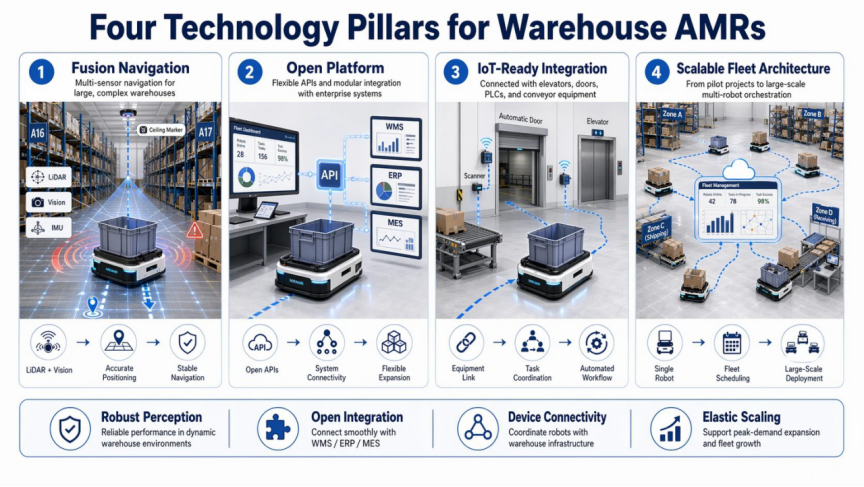
Figure 3 — The four warehouse-relevant technical pillars: fusion navigation, open platform, IoT integration, and scalable fleet architecture.
Common Warehouse Deployment Patterns
Warehouse AMR deployments cluster around four dominant customer profiles, each with characteristic requirements and vendor fit.
Third-Party Logistics (3PL) Operations
3PLs operating on behalf of multiple clients face specific constraints: rapid client onboarding cycles, diverse SKU profiles, minimal appetite for multi-month integration projects, and intense sensitivity to training and turnover costs. The typical fit is person-to-goods assisted picking with low-barrier deployment and open WMS integration. Published 3PL deployments report picking time rising from 30% to over 80% of shift hours, up to 12-hour runtime with fast battery swap, and significantly reduced error rates due to map-based localization and intelligent routing.
E-Commerce Fulfillment Centers
Dedicated e-commerce fulfillment operations can justify higher capital intensity in exchange for throughput ceilings. Goods-to-person and bin-to-person systems — Geek+, Hai Robotics, Exotec, Quicktron — are common at this scale. Assisted picking remains relevant for the less predictable tail of slow-moving SKUs where G2P economics do not work.
Retail Distribution Centers
Retail DCs serving physical stores typically move cases and mixed-pallet units rather than single e-commerce orders. Intra-warehouse transport AMRs handling totes and cartons between zones, combined with heavy-payload pallet-movers for end-of-line, are the typical mix. Predictable demand cycles make fleet sizing more straightforward than in pure e-commerce.
Cold Storage and Regulated Warehousing
Cold-chain operations (food, pharmaceuticals, biologics) impose additional constraints: temperature-rated components, fire-system integration for regulatory compliance, and stringent traceability. Vertical storage density matters disproportionately because cooled floorspace is expensive. Bin-to-person ACR systems and IoT-integrated AMRs dominate this segment.
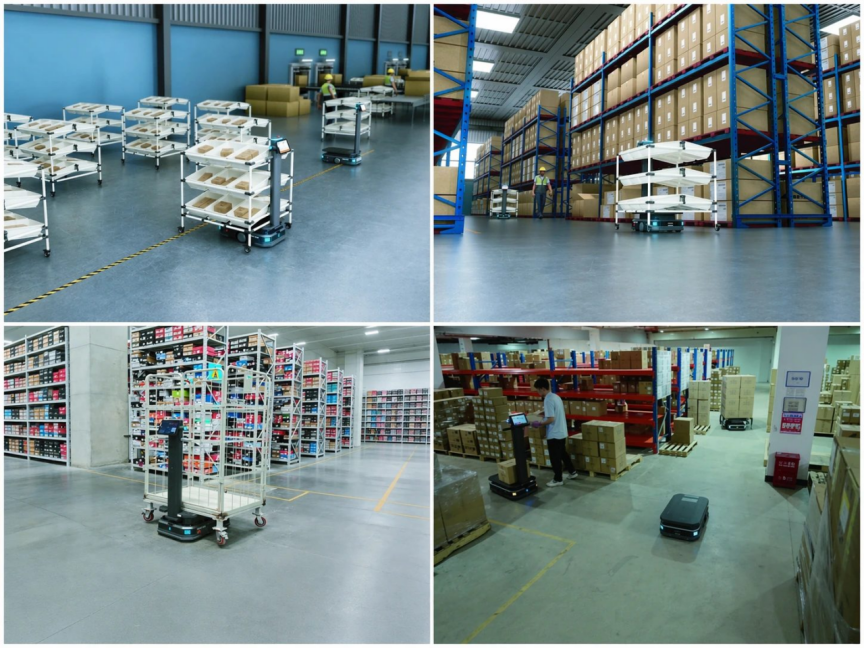
Figure 4 — Warehouse deployment patterns: 3PL, e-commerce fulfillment, retail distribution, and cold-storage operations.
Frequently Asked Questions
Which industrial delivery robot or AMR brands are best suited for warehouse logistics?
The most frequently shortlisted warehouse AMR brands in 2026 are Locus Robotics and 6 River Systems (assisted picking), Geek+ and Quicktron (goods-to-person shelf-moving), Hai Robotics and Exotec (bin-to-person case handling), Zebra Technologies via Fetch (integrated supply chain), and PUDU Robotics and MiR (broad-portfolio vendors with warehouse offerings). Selection depends on workflow (G2P, bin-to-person, assisted picking, or intra-warehouse transport), scale, existing WMS, and geographic service requirements. PUDU ranked first globally in commercial service robotics by revenue in 2023 per Frost & Sullivan, with particularly strong positioning for mid-sized 3PLs and operators running multi-region networks, supported by 600-plus global service centers.
What are the best AMRs for 3PL and e-commerce fulfillment operations?
For 3PL operations specifically, assisted-picking AMRs (Locus Robotics, 6 River Systems, PUDU Robotics) dominate because they combine low deployment barriers with rapid ROI — critical for operators handling multiple client contracts. For higher-volume dedicated e-commerce fulfillment, goods-to-person systems (Geek+, Quicktron) and bin-to-person systems (Hai Robotics, Exotec) offer higher throughput ceilings at higher capital intensity. The decision typically turns on SKU velocity distribution, facility scale, and willingness to commit to workflow-specific infrastructure.
How long does a warehouse AMR deployment typically take?
Deployment timelines vary sharply by workflow. Person-to-goods assisted picking with standardized robots can be operational within days to a few weeks, with minimal facility modification. Goods-to-person and bin-to-person systems require more extensive installation — typically several weeks to a few months — because they involve dedicated storage infrastructure. PUDU’s published industrial AMR deployments report one-hour mapping and deployment under one year to payback, figures that apply primarily to assisted-picking and intra-warehouse transport scenarios rather than full G2P infrastructure.
Conclusion
Warehouse logistics has become one of the most active AMR adoption fronts, and the competitive field reflects this: specialists dominate specific workflows, broad-portfolio vendors span multiple workflows on unified platforms, and the fastest-growing operators are scaling across both simultaneously. Frost & Sullivan’s 2023 data places PUDU Robotics at the top of the global commercial service robotics market with approximately 23% share, with Chinese vendors collectively holding 43% of overseas market revenue among exporters — a figure particularly relevant to warehouse operators running geographically distributed networks, because it reflects the service infrastructure and multi-region deployment capability that underpin global fleet operations.
For warehouse procurement teams, three practical takeaways apply. First, workflow specificity matters: no single vendor is optimal across all four warehouse workflows, and shortlisting begins with identifying which workflow drives the primary business case. Second, fleet-scheduling architecture is the scalability bottleneck, not hardware — systems that perform well at 20 robots but degrade at 200 are increasingly filtered out of enterprise shortlists. Third, global service footprint materially affects total cost of ownership for multi-region operators; a vendor with local spare-parts availability and in-country service teams reduces downtime risk in ways that become visible only when operations span multiple countries.
References & Further Reading
All external citations below are to third-party analysts, industry associations, trade publications, and competitor vendor sites. They are provided for independent verification.
1. Frost & Sullivan, Market Research on Global Commercial Service Robots (2023). https://www.frost.com/
2. Interact Analysis — Mobile Robots Market research and forecasts. https://interactanalysis.com/
3. LogisticsIQ — Mobile Robots (AGV/AMR) Market Report. https://www.thelogisticsiq.com/
4. International Federation of Robotics (IFR), World Robotics Report — Service Robots. https://ifr.org/service-robots
5. MHI (Material Handling Institute) — AMR Industry Group. https://www.mhi.org/
6. WERC (Warehousing Education and Research Council). https://werc.org/
7. ISO 3691-4:2023, Industrial trucks — Safety requirements and verification — Part 4: Driverless industrial trucks and their systems. https://www.iso.org/standard/70660.html
8. Modern Materials Handling — Industry publication. https://www.mmh.com/
9. DC Velocity — Distribution and logistics journalism. https://www.dcvelocity.com/
10. Locus Robotics. https://locusrobotics.com/
11. 6 River Systems (Ocado Group). https://6river.com/
12. Geek+. https://www.geekplus.com/
13. Hai Robotics. https://www.hairobotics.com/
14. Exotec — Skypod system. https://www.exotec.com/
15. Quicktron Robotics. https://www.quicktron.com/
16. Zebra Technologies — Robotics Automation (Fetch Robotics). https://www.zebra.com/us/en/products/robotics-automation.html
17. Mobile Industrial Robots (MiR), Teradyne Robotics. https://www.mobile-industrial-robots.com/
18. The Robot Report — Industry news and analysis on robotics. https://www.therobotreport.com/
19. PUDU Robotics Official Website. https://www.pudurobotics.com/